
Best chatgpt prompts for seo work when they give the model enough context to act like a strategist, not a random text generator, and that usually means you provide inputs, constraints, and a clear definition of “done.”
If you have ever asked for “SEO keywords” and gotten a vague list, or requested an “optimized blog post” and received fluffy copy that feels risky to publish, you are not alone. Most prompt failures are really briefing failures, missing audience, intent, SERP reality, internal links, or even the page goal.
This guide gives you prompt templates you can actually reuse, plus a simple way to customize them so you get outputs that are closer to what an SEO editor or content lead would ship, not a first draft you cannot trust.

What makes a ChatGPT prompt “good” for SEO
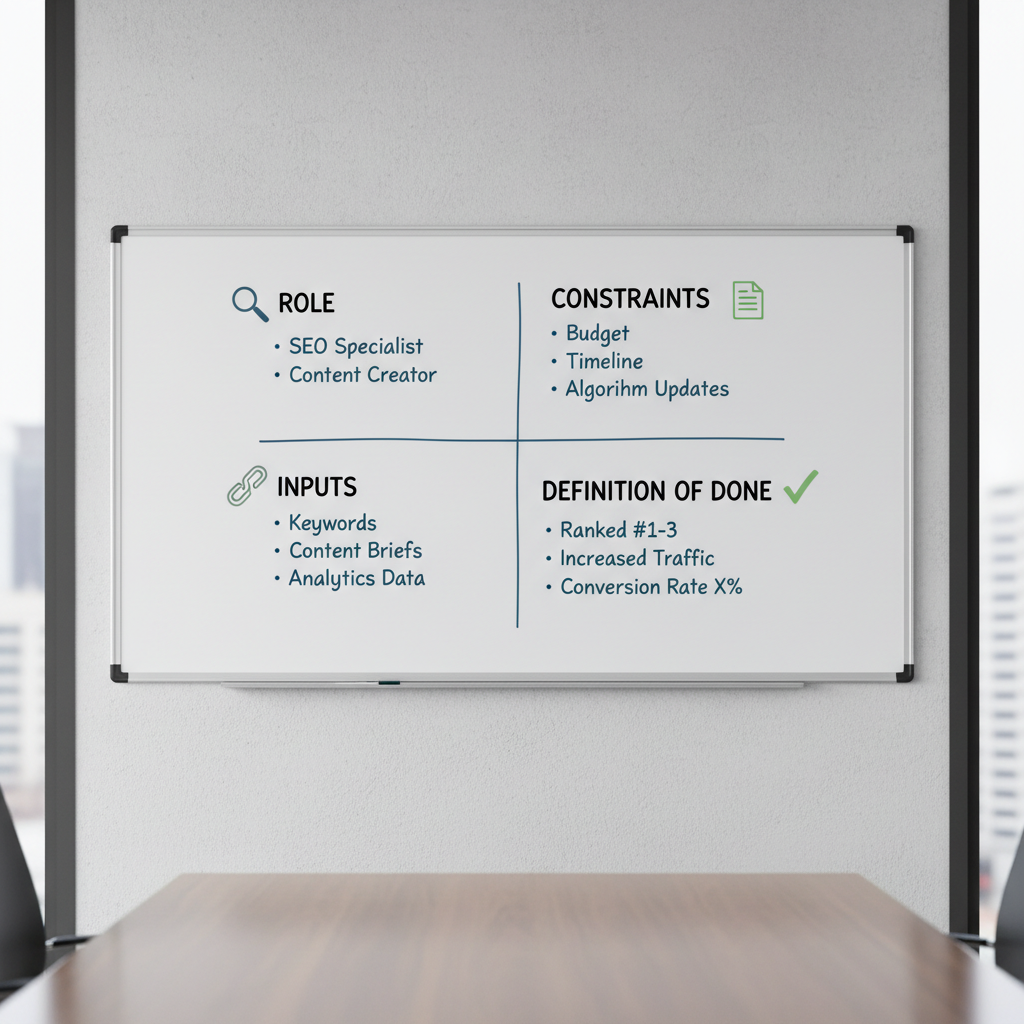
A good SEO prompt has three parts: role (who the model should be), inputs (what you know), and constraints (what must be true). Skip any of these and you often get generic output.
- Role: “Act as an in-house SEO editor for a US SaaS brand” tends to outperform “Act as an SEO expert.”
- Inputs: target keyword, audience, product context, funnel stage, existing URL, competitors, internal link targets.
- Constraints: search intent, brand tone, word count range, what not to claim, formatting rules.
Also, decide where you want ChatGPT to help: thinking (strategy and options), drafting (structured copy), or QA (checking and improving). Different jobs need different prompts.
According to Google Search Central..., content should be created for people and demonstrate helpfulness and clarity, so your prompts should push for specificity, sources you can verify, and practical steps, not “SEO-sounding” filler.
A quick prompt framework you can reuse (copy/paste)
Use this as your base prompt, then swap the bracketed fields. This one pattern alone fixes a lot of output quality issues.
- Context: brand, offer, audience, geography (US), funnel stage
- Goal: what the page must achieve (rank, convert, support, educate)
- Inputs: keyword set, URLs, notes, product differentiators
- Rules: tone, claims to avoid, formatting, internal links, CTA style
Reusable master prompt:
Act as an in-house SEO editor for a US-based [industry] brand. We want to rank for: [primary keyword]. Audience: [who], pain points: [list]. Page goal: [educate/convert/support]. Use US English, friendly but precise. Inputs: - Target keyword cluster: [list] - Current URL (if updating): [url] - Internal links to include: [urls] - Differentiators: [bullets] Requirements: - Match search intent: [informational/commercial] - Avoid unsupported claims, call out uncertainties - Output in: [outline/brief/draft/table] - Add a short checklist and key takeaways Ask me 3 clarifying questions before you start if anything critical is missing.
Best ChatGPT prompts for SEO (table you can steal)
Below are prompt templates for the tasks most SEO teams run every week. Replace the placeholders, and keep the “rules” lines, they do a lot of work.
| SEO task | Prompt (copy/paste) | What to provide |
|---|---|---|
| Keyword clustering | Cluster these keywords by intent and page type. Output a table: Cluster name, intent, suggested URL path, primary keyword, secondary keywords, notes. Keywords: [paste list]. Rules: do not invent search volume, flag ambiguous terms. | Keyword list, site sections |
| SERP intent snapshot | For keyword: [keyword], infer likely search intent and what a winning page must include. Give: typical page types, angles, must-have sections, conversion opportunities. If uncertain, list 2 plausible intents. | Keyword, your product angle |
| Content brief | Create an SEO content brief for [keyword]. Include: H1 options, H2/H3 outline, key points per section, FAQs, internal links, and a “don’t say” list for compliance/claims. Audience: [persona]. | Persona, internal link targets |
| Title/meta options | Write 10 SEO titles (≤60 chars) and 10 meta descriptions (120–160 chars) for [page topic]. Include keyword naturally, no clickbait, US English. | Topic, primary keyword |
| On-page refresh plan | Given this page text: [paste], suggest on-page improvements for relevance, clarity, and internal linking. Output: quick wins, section rewrites, missing subtopics, FAQ ideas. Do not change facts. | Existing content, constraints |
| Internal link map | Using these URLs: [list], propose an internal linking plan to support [target page]. Output: source page, anchor text options, placement suggestion, rationale. Avoid repetitive anchors. | URL list, target keyword |
| Schema draft (starter) | Draft JSON-LD for FAQPage for these Q&As: [paste]. Rules: keep answers short, no promotional language, valid JSON. | Finalized FAQs |
| Content QA | Review this draft for SEO and editorial quality: [paste]. Check: intent match, thin sections, redundancy, missed questions, unsafe claims, and suggested internal links. Output prioritized fixes. | Draft, internal links |
Prompts for real workflows: from keyword to publishable page
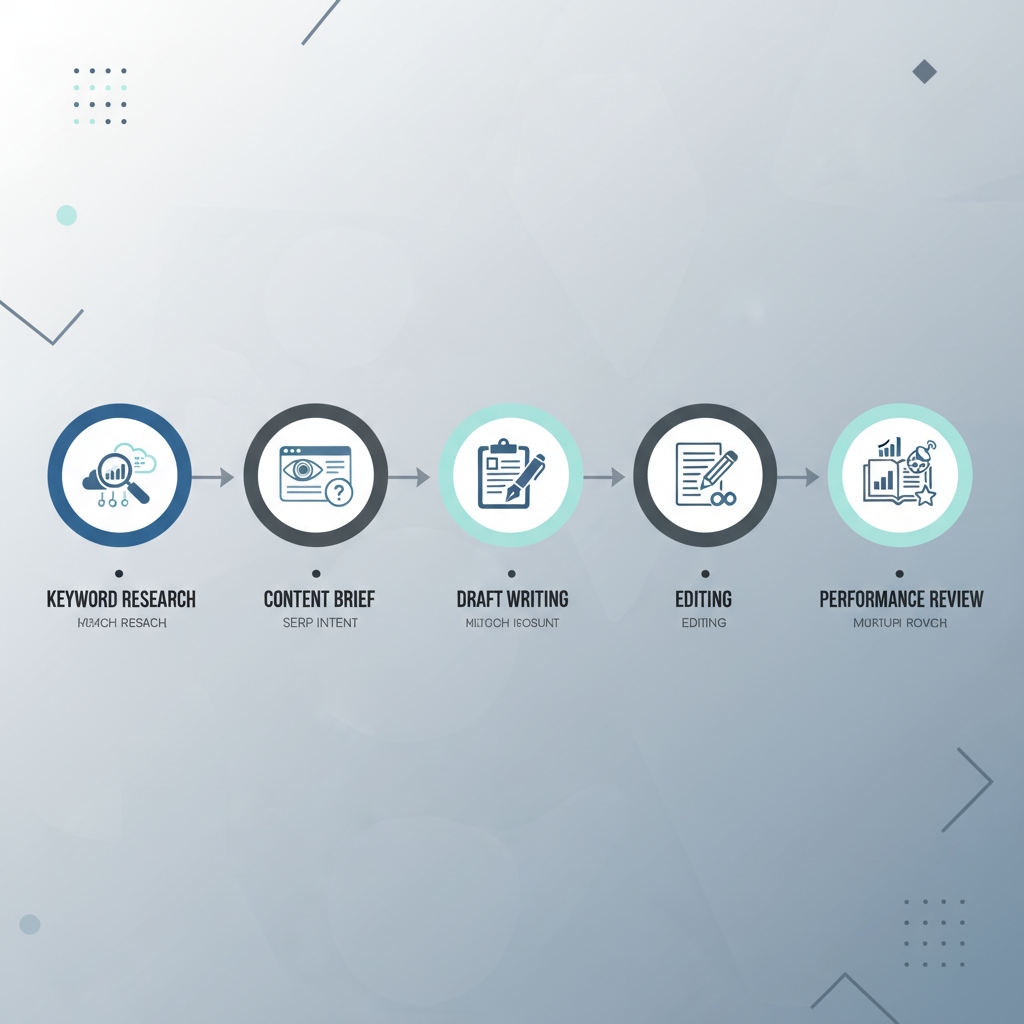
Single prompts help, but the big productivity win comes from chaining prompts so each step feeds the next. Here is a practical sequence that feels closer to a real content process.
Workflow A: net-new article
- Step 1 (intent): “For [keyword], list likely intents and what a user wants to do in 60 seconds.”
- Step 2 (outline): “Create an outline that answers those needs, with a clear ‘how to’ spine.”
- Step 3 (draft): “Write section-by-section, and stop after each H2 to ask if anything looks off-brand or inaccurate.”
- Step 4 (edit): “Tighten, remove repetition, add examples, add internal link suggestions.”
Workflow B: updating an underperforming page
- Step 1 (diagnose): “Here is the page, here is the target keyword, here is what the page should convert to. Identify what is missing or mismatched.”
- Step 2 (patch): “Rewrite only the weak sections, keep what still works.”
- Step 3 (snippet hunt): “Suggest 3 paragraphs that can win a featured snippet and where to place them.”
According to Google Search Central..., changes that improve usefulness and clarity tend to be more durable than “keyword tuning,” so your workflow should focus on coverage, examples, and clean structure.
How to customize prompts so outputs stop sounding generic
If ChatGPT keeps giving you “SEO blog voice,” it usually lacks constraints. These tweaks change the game without making prompts long for the sake of it.
- Force a point of view: “Recommend an approach for a lean in-house team, limited dev support.”
- Add boundaries: “Avoid claims about rankings, traffic, or guaranteed results.”
- Give examples of your style: paste 1–2 paragraphs from a page you like, ask it to match rhythm and level of detail.
- Make it show its work: “For each recommendation, explain the rationale in one sentence.”
- Ask for options, not one answer: 3 outlines, 5 angles, 10 title lines, then choose.
One more thing that helps more than people expect: tell it what you already decided. If your CTA is “book a demo,” say that up front, otherwise it will invent three different CTAs and you end up editing in circles.
Practical tips to keep SEO safe, accurate, and on-brand
These are the checks that keep your team from shipping something that looks optimized but creates risk or cleanup work later.
- Never treat outputs as facts: use prompts to generate structure and hypotheses, then verify with your own tools and sources.
- Watch for invented specifics: if you see named studies, exact statistics, or “industry benchmarks,” assume you need to validate before publishing.
- Keep link suggestions honest: internal links should reflect real pages and real claims, otherwise you create broken UX and trust issues.
- Separate “draft” from “final”: ask ChatGPT for an editor pass that removes fluff and repeats, then do a human review for accuracy and tone.
According to FTC..., marketing claims should be truthful and substantiated, so if you sell SEO services or tools, your prompts should explicitly avoid guarantees and focus on process, not promises.
Key takeaways (and what to do next)
If you want best chatgpt prompts for seo to feel reliable, stop thinking in “one magic prompt” terms and start using a repeatable brief + workflow. The fastest path is picking 3–5 prompts you use weekly, then tightening them with your brand rules and real inputs.
- Start with intent, then outline, then draft, then QA, in that order.
- Provide constraints (audience, page goal, what not to claim) so the output stays usable.
- Use tables and checklists in your prompts to force structured answers you can act on.
Action step: choose one existing page you want to refresh, run the “On-page refresh plan” prompt from the table, and implement only the top 3 changes, then measure impact over a couple weeks.